

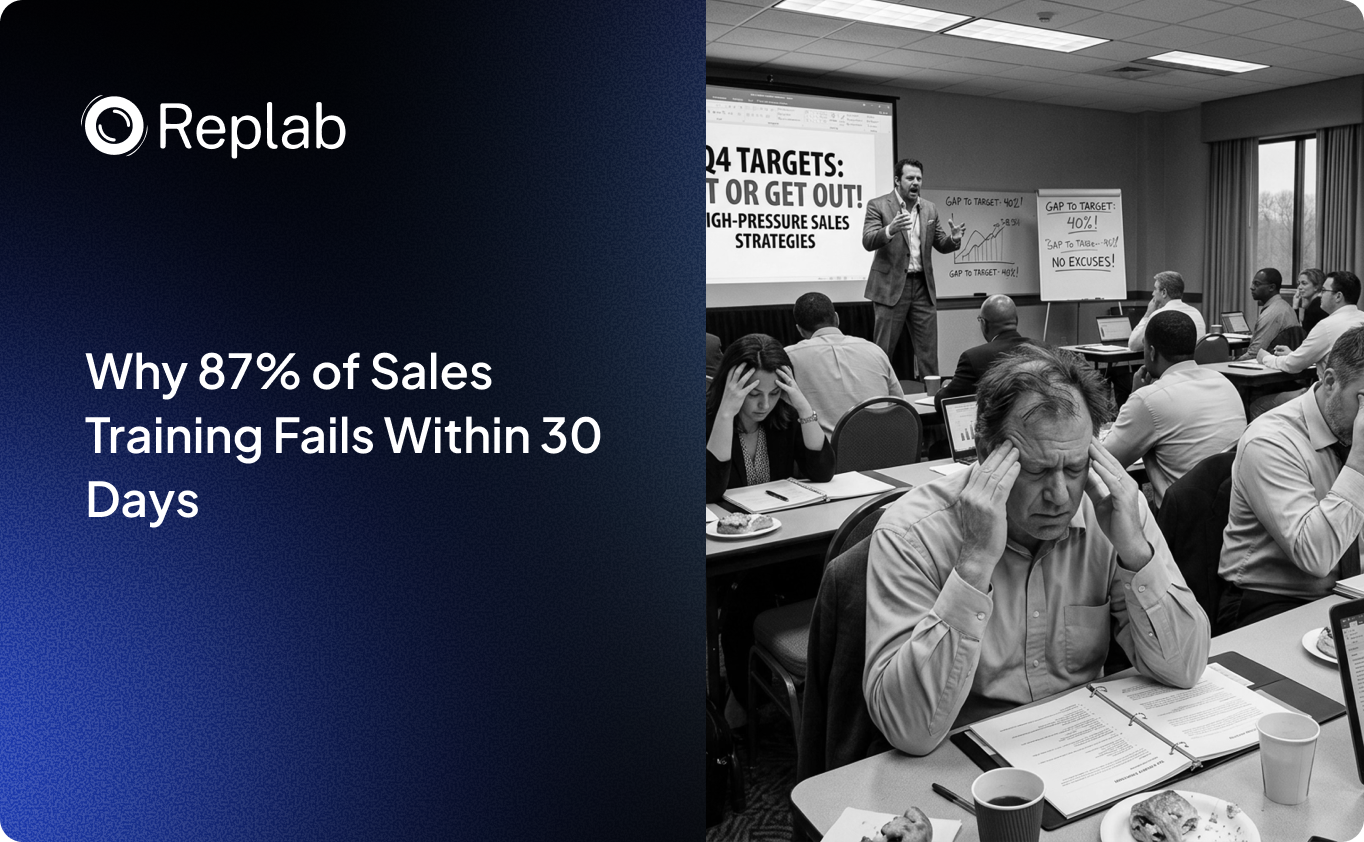
Your company just spent $2,000 per rep on a two-day sales workshop. The energy was high. The facilitator was excellent. Everyone left motivated.
Thirty days later, your team is selling exactly the way they sold before the workshop happened.
This is not a failure of effort or intention. It is a failure of biology. Hermann Ebbinghaus mapped the forgetting curve in the 1880s, and every study since has confirmed it: people forget approximately 87% of new information within 30 days without reinforcement. That means $1,740 of every $2,000 you spent evaporated before the quarter ended.
The workshop felt productive. The learning was real in the moment. But without a mechanism to practice and reinforce what was taught, the knowledge decays at a predictable, measurable rate.
The obvious answer is practice. Role-play is the single most effective method for building conversational muscle memory. Every sales methodology acknowledges this. The problem is not the method. It is the logistics.
A manager can meaningfully role-play with about 3 reps per day. If you have 50 reps across 10 locations, each rep gets manager-led practice once every two to three weeks, assuming the manager does absolutely nothing else. In reality, managers are running deals, reviewing reports, attending meetings, and handling escalations. Role-play sessions get pushed, shortened, or canceled entirely.
Peer role-play is worse. Reps practicing with other reps tend to reinforce average behavior rather than top performance. And most reps avoid it because practicing with a colleague feels awkward and unproductive.
The result: every sales organization agrees that role-play is the best training method, and almost none of them do it consistently.
Behavioral science points to three requirements for skill retention: spaced repetition, realistic practice, and immediate feedback. Classroom training provides none of these after the session ends.
AI sales role-play provides all three simultaneously. Every rep gets a realistic AI buyer to practice with, anytime, on any device. The AI adapts to the rep's responses, pushes back on weak answers, and scores every session against the organization's specific criteria.
Sessions are short. Three to five minutes. A rep can practice before an appointment, during a break, or at the start of their shift. The practice is spaced naturally across days and weeks rather than crammed into a single workshop.
The feedback is immediate and specific. Not "work on your objection handling" but "at the 2-minute mark, the customer raised a price concern and you moved to discount before exploring what they actually valued. Here is the reframe your top performers use at that moment."
Organizations using AI role-play report 78% faster training proficiency. New hire ramp time drops by approximately 20 days. Conversion rates improve by 23% among reps who practice consistently.
These are not improvements from a better workshop or a more engaging facilitator. They are improvements from giving reps a way to practice the actual conversations they face, with feedback that arrives in seconds rather than weeks.
For dental practices and DSOs, where Treatment Coordinators present $20,000 to $40,000 cases and the national average Case Acceptance Rate sits at 40-50%, the impact of consistent practice is particularly significant. A TC who has rehearsed the financing introduction, the price objection response, and the "I need to think about it" conversation 20 times before their next real patient is a fundamentally different presenter than one operating on instinct alone.
The question is no longer whether to invest in sales training. It is whether your training investment includes a reinforcement layer that prevents 87% of it from disappearing.
Workshops teach concepts. AI role-play builds habits. The companies seeing the strongest results are doing both: teaching the methodology in a structured program, then reinforcing it daily through AI role-play practice that keeps the skills sharp between sessions.
The forgetting curve is not a problem you can motivate your way past. It is a biological reality. The only solution is practice, and practice at scale requires AI.

1K+ Trusted by Pros
Rep Labs AI role playing with our AI coach trains reps fast to scale your sales and service.
.svg)